
Modern churches are rethinking how they communicate; because the congregation itself has changed. Many worshipers still value being in the room every Sunday, but more people now engage through livestreams, replays, and short clips shared during the week. That hybrid rhythm has made visuals part of the message, not just something on the stage.
When planned well, LED walls help turn lyrics, scripture, and key sermon points into something people can follow instantly; even from a phone screen. For many ministries, that clarity makes a real difference.


There’s also a generational shift happening. Younger worshippers grew up surrounded by sharp visuals, smooth transitions, and intentional design. When the room feels outdated, attention fades. When visuals feel clear and cohesive, focus naturally returns to worship. That’s where LED video walls make sense. They combine modern LED technology with the heart of a timeless message, keeping music, teaching, prayer, and announcements visually unified.
The strongest results appear when churches treat the system as a ministry tool, not a piece of tech. Because LED display panels can be sized around the stage, ceiling height, and camera framing, they allow leaders to communicate with confidence. With reliable LED panels running week after week, the impact grows… And the message lands the way it’s meant to.
Why Visual Communication Matters in Modern Churches
Church visuals have always played a role, but expectations around clarity and consistency have shifted. Today’s worship environments blend live music, teaching, and real-time video, which means the display system must support the moment; not compete with it.
From traditional screens to immersive worship environments
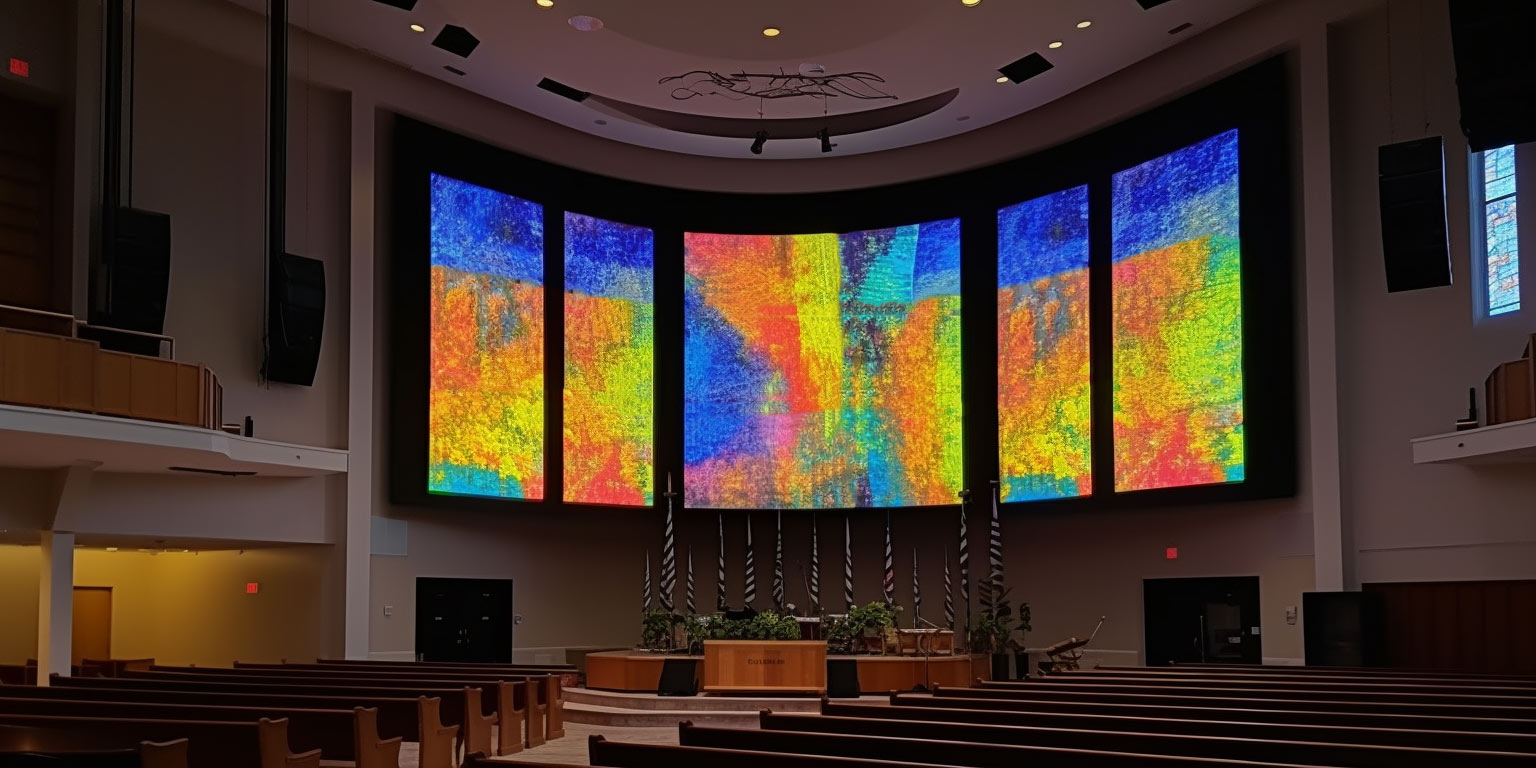
Not long ago, many sanctuaries relied on projectors or a few mounted TVs. They worked; until rooms got larger, lighting became more dynamic, and content moved faster. Today, churches design experiences where LED walls frame the platform, reinforce sermon themes, and make lyrics feel like part of the space itself.
The difference isn’t simply “more technology.” It’s greater control over brightness, color, and readability in an environment that changes every single week.
With LED displays for churches, pastors can share close-up camera feeds during teaching, while worship teams run motion backgrounds that remain smooth thanks to a high Refresh Rate. When the Resolution matches the seating distance and the Pixel Pitch is selected for the room (not just the spec sheet) the image stays clean instead of pixelated up close. Add Auto-adjustable brightness, and content remains comfortable whether the lights are up for note-taking or lowered during worship.
Keeping the message clear for every seat
Very few churches have perfect sightlines. Some rooms are wide and shallow, others are deep with balconies, and many include columns, angled seating, or side sections. The goal, however, stays simple: everyone should see the same message at the same moment.
That’s why viewing performance matters more than raw screen size. A wide View Angle (often between 140° and 160°) helps maintain color consistency from the sides, while proper scaling keeps text readable even from the back row.
Maintenance also plays a role in long-term clarity. LED display panels with full front service simplify upkeep, especially in tight stages where rear access isn’t possible. Magnetic modules allow quick swaps when something needs attention. And for many churches, lightweight cabinets reduce structural stress; particularly when using a flown method above the platform or when aiming for a clean, wall-mounted appearance.
Supporting both in-person and online congregations
Hybrid ministry works best when the room and the stream feel connected. LED screens integrate naturally with cameras, switchers, and streaming systems so online viewers experience the same moments as those sitting in the sanctuary.
Many churches run a mix of synchronized live video during worship and scheduled content loops before or after services. That flexibility turns LED panels into a communication backbone rather than a Sunday-only feature.
Reliability matters here as well. Outdoor services, Easter gatherings, and courtyard events often require outdoor LED video walls that can handle environmental exposure. Durability ratings such as IP45 or IP65 become important when moisture, dust, or temperature shifts are involved.
Inside the building, churches benefit from control systems that support multiple inputs (HDMI, SDI, media servers, and more) while remaining compatible with presentation software and production workflows. Just as important, the system should leave room for future tools and upgrades as ministry needs continue to grow.

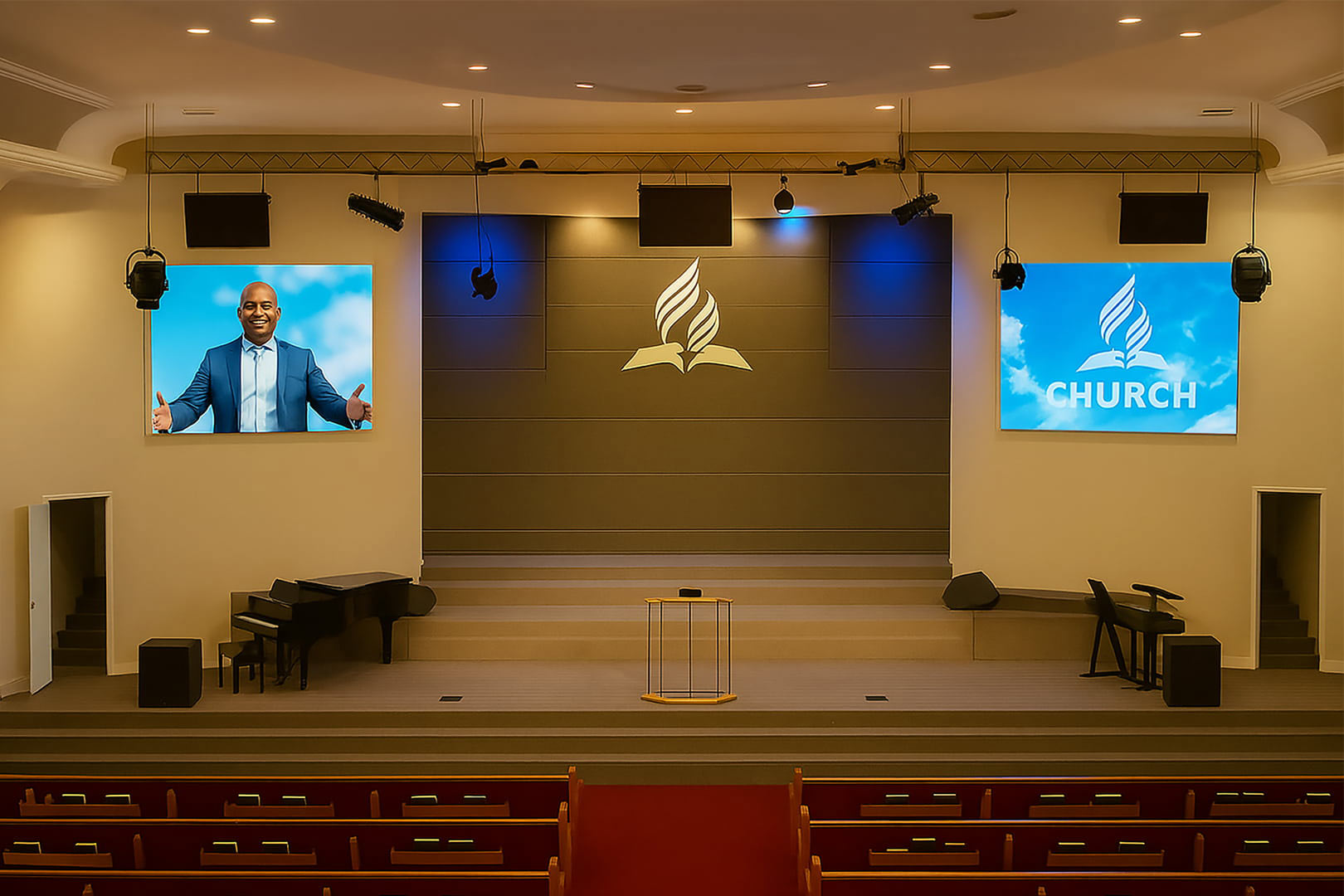


Get full technical support for your virtual stage — from LED configuration to camera sync and installation.

Designing LED Screens Around the Church Space
Every sanctuary has its own personality, which is exactly why thoughtful planning matters. The most effective LED wall packages are designed around architecture, workflow, and how people actually worship in that space.
No two churches are alike. Some feature tall ceilings and deep auditoriums, while others work with narrow stages or historic structures that can’t be altered. A proper design process considers installation methods early: ground support for portable setups, wall-mounted systems for permanent stages, or flown methods when height and visibility are essential. These choices also affect cable routing, service access, and camera angles for livestreams.
Respect for the space is key. Clean installations focus on hidden cabling, precise edges, and hardware that doesn’t feel industrial. Churches often choose LED displays that look seamless both in the room and on camera, allowing attention to remain on the service itself. When done right, the technology fades into the background (exactly where it should be) .
For ministries that gather outdoors or host seasonal events, environmental planning becomes even more important. Choosing LED display panels with appropriate durability, along with weather-aware mounting and power strategies, helps prevent one unexpected storm from turning into a costly interruption.


LED Walls That Serves the Message: Not the Other Way Around
The best church visuals are the ones no one thinks about during the service. When worship is live, transitions are timed, and cameras are rolling, the system must be stable, intuitive, and ready to grow alongside the congregation.
Stability begins with professional control. A reliable video processor and sending card (such as a NovaStar setup) keeps lyrics, graphics, and camera feeds synchronized without tearing or timing issues. Many churches run both live IMAG and motion content, and consistent refresh performance helps protect the experience when it matters most. The goal isn’t complexity… It’s predictability.
Content management should also match volunteer realities. Most churches don’t have full broadcast teams, so workflows need to feel familiar: simple playlists, intuitive software, and smooth handoffs between worship and teaching segments. LED screens that integrate cleanly with common presentation tools reduce training time and avoid situations where “only one person knows how to run it.”
Churches also evolve. Campuses expand, stages change, and online audiences grow. Scalable LED solutions (along with compatible LED devices such as cameras, switchers, and media players) make it easier to expand width, increase height, or upgrade processing later without replacing the entire system. As time passes by, that flexibility protects ROI, especially when paired with full front service designs that reduce downtime. A long 5-year warranty helps as well, giving ministries confidence when planning budgets year after year.
Working With a Partner Who Understands Worship Environments
In the end, the biggest difference isn’t found on a spec sheet… It’s found in guidance. Churches benefit most from working with a partner who understands how worship spaces function: where people sit, how cameras frame the stage, what volunteers operate, and how installations must respect the environment.
A strong process begins with consultation; evaluating the room, planning brightness around stage lighting, and selecting the right pixel pitch and resolution so text remains clear without overspending. It continues through commissioning and training, ensuring teams feel confident long before the first Sunday service.
That level of support matters whether the project involves a small sanctuary or a multi-campus auditorium. The right provider adapts solutions to each church’s culture and budget, recommends appropriate installation methods, and stays available when timelines get tight.
That’s the approach offered by American LED Screens, a U.S.-based provider of LED video walls and related services, bringing hands-on experience in worship environments with a focus on thoughtful planning, dependable support, and long-term success.

Get everything you need